
When preparing documents for international use, one of the most common questions businesses face is what type of document authentication is needed. Choosing the correct process is essential. Selecting the wrong path can lead to rejected documents, delays, and additional costs.
In many cases, the confusion comes from a third component: embassy legalization. Understanding how all three elements work together is key to ensuring documents are accepted abroad.
For organizations managing cross-border operations, these distinctions are more than procedural details. Document authentication directly impacts timelines for international expansion, contract execution, regulatory approvals, and global compliance. Having a clear understanding of when each method applies helps businesses avoid disruptions and move forward with confidence in international markets.
What Is an Apostille?
An apostille is a simplified form of document authentication used for countries that are members of the Hague Apostille Convention. It certifies the authenticity of a public official’s signature, seal, or stamp on a document.
Apostilles are typically issued at the state level for documents such as:
- Corporate records
- Notarized agreements
- Vital records
- Powers of attorney
Once an apostille is issued, the document can be used directly in any Hague Convention country without further steps.
What Is the US Department of State Authentication?
US Department of State authentication is a federal certification step used for documents intended for countries that are not part of the Hague Apostille Convention.
It verifies the authority of the state official who authenticated the document and prepares it for the next stage, which is embassy legalization.
What Is Embassy Legalization?
Embassy legalization is the final step required for documents being used in non-Hague countries.
This process is handled by the destination country’s embassy or consulate and confirms that the document is valid for use within that specific jurisdiction.
Embassy legalization is country-specific, meaning requirements, processing times, and procedures can vary significantly depending on the destination.
How Apostille, Authentication, and Legalization Work Together
The correct process depends entirely on the destination country:
For Hague Convention Countries
- Apostille is the only step required
- No embassy legalization is needed
For Non-Hague Countries
Documents must go through a multi-step process:
- Notarization or document issuance
- State authentication
- US Department of State authentication
- Embassy legalization
Each step builds on the previous one to ensure the document is fully validated for international use.
Key Differences Between Apostille and Authentication
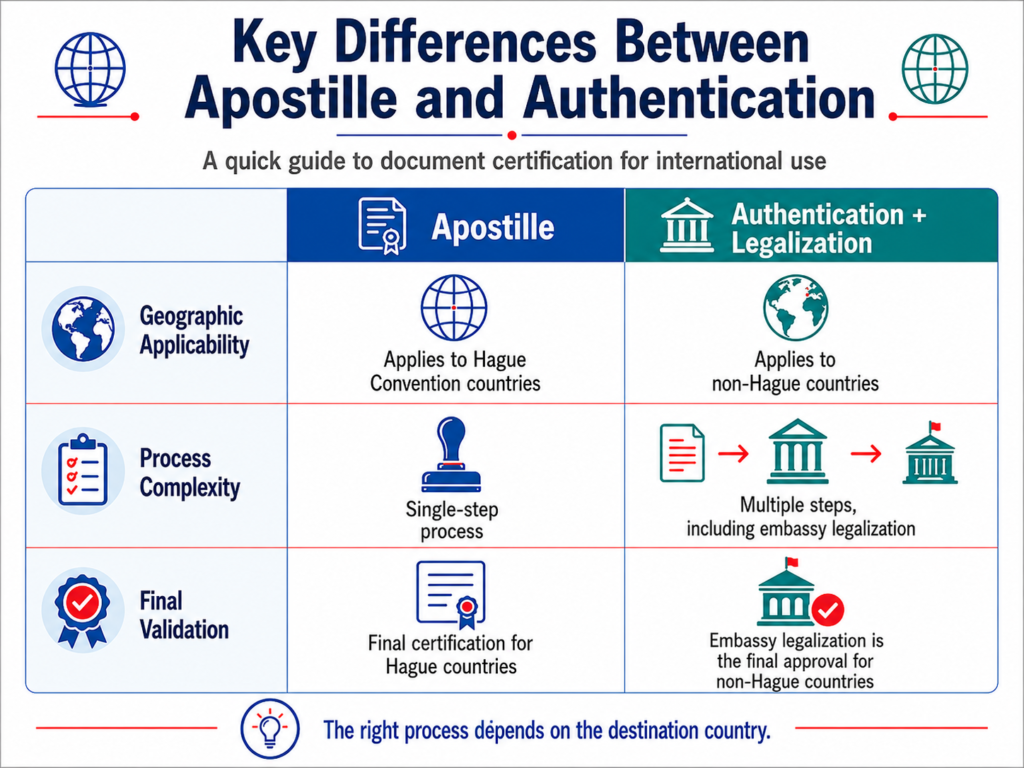
Geographic Applicability
- Apostille applies to Hague Convention countries
- Authentication and legalization apply to non-Hague countries
Process Complexity
- Apostille is a single-step process
- Authentication requires multiple steps, including embassy legalization
Final Validation
- Apostille is the final certification for Hague countries
- Embassy legalization is the final approval for non-Hague countries
How to Determine Which Process You Need
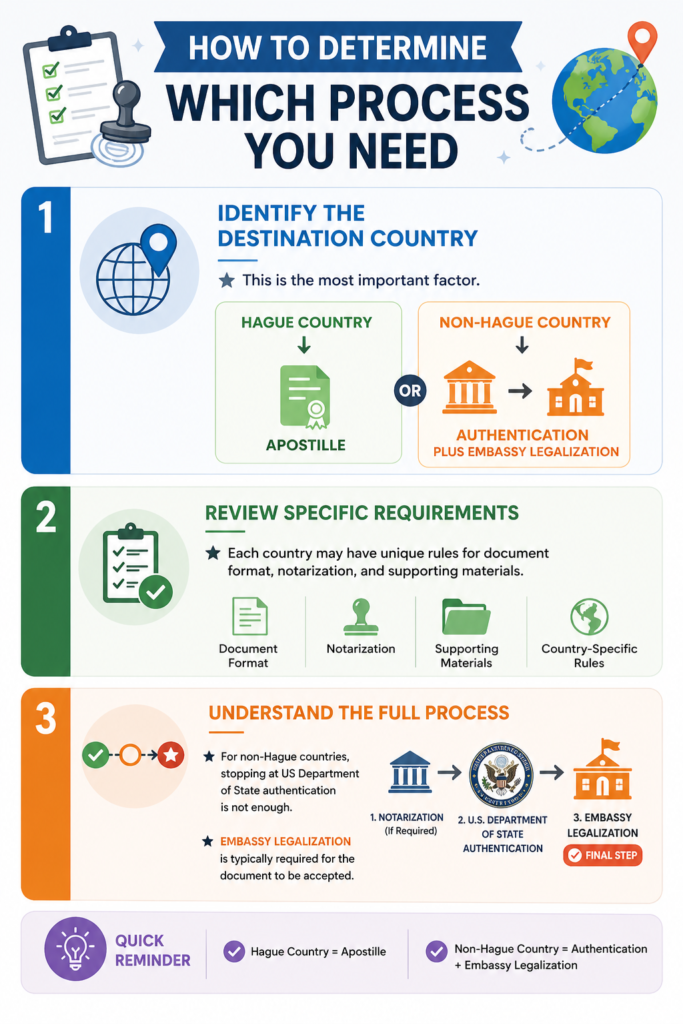
1. Identify the Destination Country
Identifying the destination country is the most critical step in determining the correct document authentication process. The requirements vary depending on whether the country is a member of the Hague Apostille Convention. If the destination country is part of the Hague Convention, an apostille is sufficient. However, if the country is not a member, the document must go through a more involved process that includes authentication and embassy legalization.
2. Review Specific Requirements
It is essential to review the specific requirements of the destination country before proceeding. Each country may have its own rules regarding document formatting, notarization, and any additional supporting materials that must be submitted. Understanding these requirements in advance helps prevent delays and ensures that documents are processed correctly the first time.
3. Understand the Full Process
Having a clear understanding of the full authentication process is especially important for non-Hague countries. In these cases, completing authentication through the U.S. Department of State is only one step in the process. Embassy legalization is typically required afterward for the document to be fully recognized and accepted in the destination country.
Common Mistakes to Avoid
- Assuming authentication and legalization are the same
- Skipping the embassy legalization step for non-Hague countries
- Using an apostille for a country that does not accept it
- Submitting documents that are not properly notarized or certified
These errors often result in delays and resubmissions.
Why This Distinction Matters for Businesses
For organizations operating across borders, document authentication is directly tied to compliance and operational timelines.
Understanding when embassy legalization is required helps:
- Prevent rejected documents
- Avoid unnecessary delays
- Ensure acceptance by foreign authorities
- Support efficient international operations
For businesses managing these requirements regularly, working with an experienced provider such as Washington Consular Services can help ensure documents are handled accurately and move through each stage of the process efficiently.
Key Takeaways
- An apostille is used for Hague Convention countries and requires only one step
- US Department of State authentication is part of a multi-step process for non-Hague countries
- Embassy legalization is the final step for documents going to non-Hague countries
- The destination country determines which process is required
- Apostilles are generally faster, while authentication and legalization take more time
- Skipping embassy legalization for non-Hague countries will likely result in rejection
- Understanding the full process helps businesses avoid delays and compliance issues