
International business is becoming increasingly digital, and document authentication is evolving along with it. An e-Apostille for international documents can help modernize a process that has traditionally relied on physical paperwork, attached certificates, shipping, and manual handling.
For global businesses, this shift has the potential to make international document authentication faster and more efficient. However, electronic processing does not mean every document or destination follows the same requirements. Companies still need to understand what an e-Apostille is, when it can be used, and whether it will meet the requirements of the organization receiving the document.
As electronic authentication continues to develop, understanding how an e-Apostille for international documents works is becoming increasingly important for businesses operating across borders.
What Is an E-Apostille for International Documents?
An e-Apostille is the electronic equivalent of a traditional Apostille.
An Apostille authenticates the origin of a public document so it can be recognized in another country where the Hague Apostille Convention applies. Traditionally, the Apostille is issued as a physical certificate attached to or associated with a paper document.
An e-Apostille for international documents performs the same essential function electronically. It can be digitally issued and associated with an electronic public document, helping reduce reliance on paper-based authentication workflows.
An e-Apostille does not represent a different level of authentication. It serves the same general purpose as a traditional Apostille while using an electronic format.
How Does an E-Apostille for International Documents Work?
The process depends on the document, the issuing authority, and the requirements of the destination country.
In an electronic workflow, an eligible public document may be submitted to the appropriate authority for authentication. The authority can then issue an electronic Apostille that is digitally associated with the document.
Once completed, the authenticated document may be transmitted electronically rather than being shipped as a physical package. This can make an e-Apostille for international documents especially useful for businesses that regularly send important corporate, legal, or regulatory documents overseas.
Why Are E-Apostilles Becoming More Important?
Businesses increasingly create, approve, store, and exchange documents electronically. Electronic authentication is a natural extension of that shift.
Traditional authentication can involve several physical steps. Documents may need to be printed, signed or notarized, delivered to the appropriate authority, authenticated, and then shipped internationally.
When electronic processing is available and appropriate, an e-Apostille may help reduce some of that physical handling.
Potential advantages include:
- Faster electronic transmission of authenticated documents
- Reduced dependence on international shipping
- Less handling of original documents
- Easier electronic document storage
- More efficient workflows for global teams
- Greater ability to manage international documents digitally
These benefits can be particularly valuable for companies dealing with time-sensitive transactions or large volumes of international documentation.
E-Apostilles and Digital Document Authentication
The move toward e-Apostilles is part of a broader shift toward digital document authentication. The long-term goal is not simply to replace a paper Apostille certificate with an electronic file. Instead, authentication processes may increasingly allow documents to be issued, authenticated, verified, and transmitted digitally.
For global companies, this can create a more streamlined process for handling corporate and legal documents across multiple jurisdictions. An e-Apostille for international documents can therefore play an important role in helping businesses adapt to increasingly digital international transactions.
What Types of International Documents May Need an Apostille?
Businesses use Apostilles for a wide variety of international purposes.
Depending on the transaction and destination, documents may include:
- Corporate documents
- Powers of attorney
- Certificates of incorporation
- Certificates of good standing
- Commercial documents
- Licenses
- Agreements
- Educational documents
- Birth and marriage certificates
- Criminal background checks
For businesses, these documents may be required when establishing overseas operations, opening foreign bank accounts, completing regulatory filings, entering international transactions, or working with foreign government authorities.
Whether an e-Apostille is available will depend on the document, the issuing authority, and the destination requirements.
E-Apostille vs. Traditional Apostille
Both traditional and electronic Apostilles are designed to authenticate documents for international use, but the format and processing method can differ.
A traditional Apostille is generally issued as a physical certificate associated with a paper document. The completed document may then need to be shipped or physically delivered.
An e-Apostille is issued electronically and may be transmitted digitally. For global businesses, an e-Apostille for international documents can reduce physical handling and make authentication more compatible with digital workflows.
However, companies should not assume that an electronic Apostille is always the correct option. The appropriate format depends on the document, issuing authority, destination country, and receiving organization.
Can Every International Document Receive an E-Apostille?
Not necessarily.
The availability of an e-Apostille can depend on several factors, including:
- The type of document
- Where the document was issued
- Which authority has jurisdiction
- Whether electronic Apostilles are available from that authority
- The destination country
- The requirements of the receiving organization
This is why businesses should confirm the correct authentication process before submitting documents. Digital processing may simplify authentication, but it does not eliminate document-specific or country-specific requirements.
Digital Authentication Does Not Eliminate Preparation Requirements
Even when an e-Apostille for international documents is available, the underlying document must still meet the appropriate requirements.
Depending on the document, businesses may need to determine:
- Whether notarization is required
- Whether the document must be certified
- Which authority should authenticate the document
- Whether an Apostille is appropriate for the destination
- Whether the receiving organization accepts an electronic document
- Whether additional preparation is required before authentication
Errors at the beginning of the process can lead to delays regardless of whether the final Apostille is issued electronically or on paper.
What About International Documents for Non-Hague Countries?
An e-Apostille only applies when an Apostille is the appropriate form of authentication. If a document will be used in a country where the Hague Apostille Convention does not apply, the document may require a different process, such as authentication followed by Embassy or Consular Legalization.
Depending on the destination, this can involve several government and embassy steps. For businesses, identifying whether an international document requires an Apostille or Legalization should be one of the first steps in the authentication process.
What E-Apostilles Mean for Global Businesses
The growing use of electronic authentication reflects a broader change in how businesses and government authorities manage official documents.
For companies operating internationally, increased adoption of e-Apostilles may provide several practical benefits, including faster document delivery, reduced reliance on paper, and easier collaboration between offices in different countries.
An e-Apostille for international documents may also help businesses manage authentication more efficiently when documents must move quickly between international teams, legal departments, government authorities, and business partners.
At the same time, international document authentication remains dependent on specific document and destination requirements.
Technology can simplify the process, but businesses still need to determine the correct authentication path before proceeding.
How to Prepare International Documents for Authentication
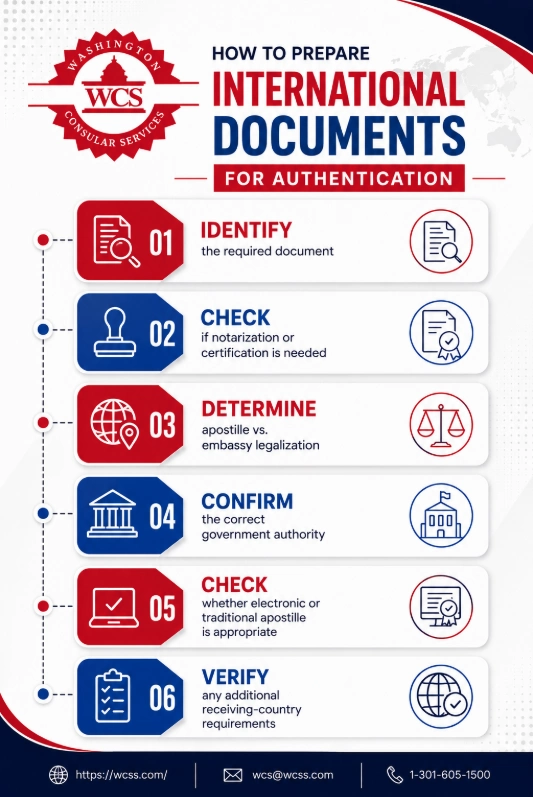
Companies that regularly send documents overseas should consider authentication requirements early in the process.
Before submitting a document, confirm:
- What document the receiving authority requires.
- Whether the document must be notarized or certified.
- Whether the destination requires an Apostille or Embassy Legalization.
- Which government authority has jurisdiction over the document.
- Whether an electronic or traditional Apostille is appropriate.
- Whether the receiving organization has additional requirements.
Taking these steps early can help reduce delays, rejected documents, and unnecessary reprocessing.
Get Help With E-Apostilles for International Documents
Electronic authentication is changing how documents move across borders, but determining the correct process still requires careful attention to the document, issuing authority, and destination country.
Washington Consular Services (WCS) has more than 40 years of experience providing Apostille and document Legalization services for global businesses.
Whether your documents require an e-Apostille for international documents, a traditional Apostille, or Embassy Legalization, WCS can help determine the appropriate authentication process and support your international document needs.
Key Takeaways
- An e-Apostille for international documents is the electronic equivalent of a traditional Apostille and is used to authenticate eligible documents for use abroad.
- E-Apostilles can help reduce paper handling, international shipping, and processing delays when electronic authentication is available.
- Businesses may use Apostilles for corporate documents, powers of attorney, certificates of incorporation, certificates of good standing, and other international documents.
- Not every document or destination is eligible for an e-Apostille, so requirements should be confirmed before submission.
- Documents intended for non-Hague countries may require authentication and embassy or Consular Legalization instead of an Apostille.
- WCS can help businesses determine the correct authentication process based on the document type and destination country.