
For pharmaceutical companies entering international markets, regulatory approval depends on more than the product itself. The documents supporting a pharmaceutical product may also need to be authenticated before a foreign regulatory agency, ministry, importer, or other authority will accept them.
Depending on the destination country, that authentication process may involve an Apostille or Consular Legalization.
Understanding which process applies, and preparing pharmaceutical documents correctly from the beginning, can help Regulatory Affairs teams reduce unnecessary delays and keep international registrations, renewals, and market-entry initiatives moving forward.
As pharmaceutical companies expand into new markets, document requirements can become increasingly complex. Different countries may follow different authentication procedures, and the correct process can depend on the type of document, the issuing authority, and the requirements of the receiving organization. Addressing these details early can make the overall regulatory submission process more efficient and predictable.
Why Pharmaceutical Documents May Require Authentication
Pharmaceutical companies routinely submit official documents to support overseas regulatory filings and import approvals.
One important example is the Certificate of Pharmaceutical Product (CPP). A CPP is commonly used as part of the documentation supporting pharmaceutical products in foreign markets. The FDA also issues electronic Certificates of Pharmaceutical Product, or eCPPs.
Before a CPP or other supporting document can be accepted overseas, the destination country may require authentication confirming that the document is legitimate and suitable for international use.
The exact authentication path depends largely on where the document will be presented.
Apostille vs. Consular Legalization for Pharmaceutical Documents
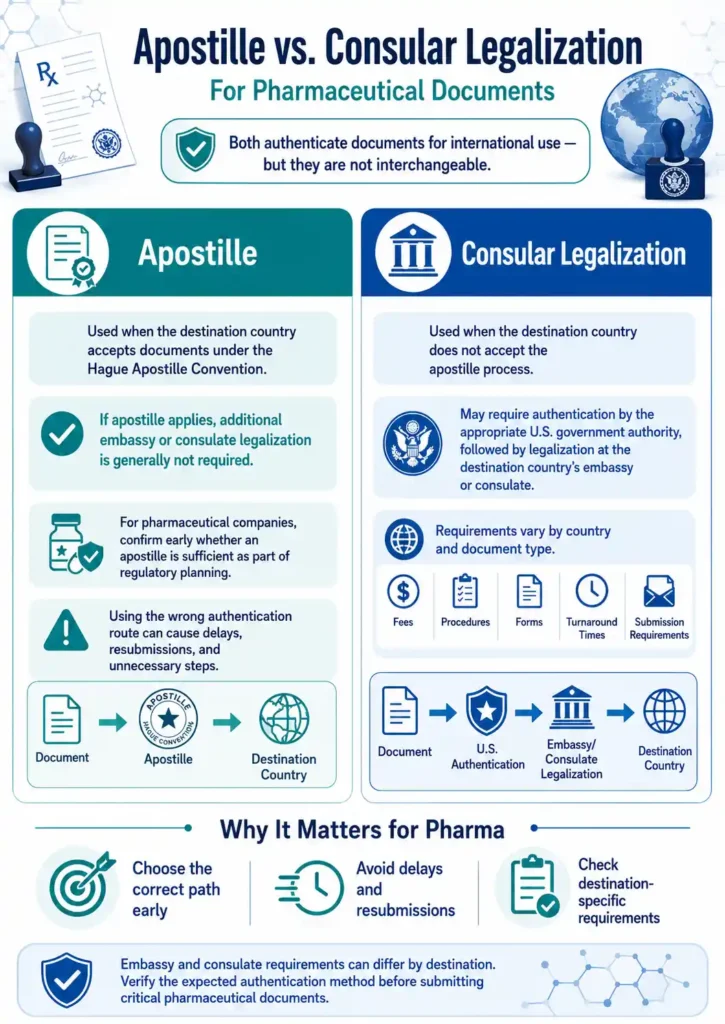
Although both processes authenticate documents for international use, an Apostille and Consular Legalization are not interchangeable.
Apostille
An Apostille is used when the destination country accepts documents under the Hague Apostille Convention. When the appropriate Apostille process applies, the document generally does not need to undergo additional legalization through the destination country’s embassy or consulate.
For pharmaceutical companies, determining whether an Apostille is sufficient should be done early in the regulatory planning process. Sending a document through an unnecessary legalization step, or obtaining an Apostille when the receiving authority expects another form of authentication, can lead to delays and resubmissions.
Consular Legalization
When the destination does not accept the Apostille process, documents may require a more extensive authentication and legalization procedure.
Depending on the document and country, this can involve authentication through the appropriate U.S. government authority followed by legalization at the embassy or consulate of the destination country. Because embassy requirements can differ by destination, fees, processing procedures, forms, turnaround times, and submission requirements may also vary.
Authentication of Certificates of Pharmaceutical Product
A Certificate of Pharmaceutical Product (CPP/eCPP) is one of the most important documents pharmaceutical companies may need authenticated for overseas use. Because FDA export certificates are federal documents, CPPs are typically authenticated through the U.S. Department of State when authentication is required. Depending on the destination country, additional embassy or consulate legalization may also be necessary.
For electronic CPPs, the authentication workflow generally begins after the pharmaceutical company receives the eCPP from the FDA. Managing this process efficiently can help Regulatory Affairs teams reduce the number of handoffs involved across agencies, couriers, requirements, and status updates.
Why Authentication Matters to Pharmaceutical Regulatory Teams
Document authentication can appear to be a relatively small administrative component of a larger regulatory submission. In practice, however, a missing or incorrectly authenticated document can affect the timing of the entire project.
Delays may occur when:
- The wrong authentication process is selected for the destination country.
- A document is submitted in an unacceptable format.
- An embassy or consulate requirement is overlooked.
- Authentication requirements are identified too late in the regulatory timeline.
- Teams lack visibility into where a document is within the authentication process.
For pharmaceutical companies managing registrations across multiple countries, these issues can multiply quickly.
Building authentication into the regulatory workflow from the beginning creates greater predictability and gives teams more time to address country-specific requirements.
Planning Authentication Before a Pharmaceutical Submission
A more efficient authentication process begins with several basic questions:
What document is being submitted?
Requirements can differ based on whether the document is a CPP, corporate document, power of attorney, agreement, certificate, or another regulatory record.
Where will the document be used?
The destination country is one of the most important factors in determining whether Apostille or Consular Legalization applies.
Which authority issued the document?
Federal documents such as FDA-issued export certificates may follow a different authentication path than state-issued or notarized documents.
Does the receiving authority have specific requirements?
Country requirements and individual regulatory authorities can affect how a document must be prepared and authenticated.
Confirming these details before submitting documents can help prevent unnecessary rework.
Creating a More Predictable Pharmaceutical Document Workflow
International Regulatory Affairs teams often manage many documents simultaneously across several countries.
Instead of treating authentication as an isolated final task, companies can incorporate it into their broader regulatory operations.
A standardized workflow can include:
- Identifying the destination country and receiving authority.
- Confirming whether Apostille or Consular Legalization is required.
- Preparing the appropriate document or electronic certificate.
- Completing required U.S. authentication steps.
- Completing embassy or consulate legalization when necessary.
- Tracking the document throughout the process.
- Returning or forwarding the completed documents according to the regulatory team’s requirements.
Centralizing these steps can reduce handoffs and give internal teams clearer visibility into document status.
Before Sending Pharmaceutical Documents Overseas
Authentication requirements should be confirmed before documents are submitted to a foreign authority.
The most important distinction is straightforward:
Countries accepting the Hague Apostille Convention generally use an Apostille, while other destinations may require authentication followed by embassy or Consular Legalization.
Because the appropriate process also depends on the document itself, pharmaceutical companies should confirm requirements for each destination rather than assuming that the same authentication process applies across every market.
Identifying the correct path at the beginning of the process can help Regulatory Affairs teams reduce unnecessary delays, avoid resubmissions, and maintain a more predictable timeline for international filings.
How WCS Can Help
Washington Consular Services (WCS) helps pharmaceutical and life-sciences companies manage the authentication of documents intended for international use. For more than 40 years, WCS has helped businesses navigate Apostille, U.S. Department of State authentication, and embassy or consulate legalization requirements.
WCS also gives companies a centralized way to submit orders, manage documents, and track their status throughout the process. For Regulatory Affairs teams handling multiple products, markets, and submission deadlines, working with an experienced document authentication provider can make an otherwise fragmented process easier to manage.
Need help authenticating a CPP, eCPP, or other pharmaceutical document for international use? Contact WCS to determine the appropriate apostille or legalization process for your destination country.
Key Takeaways
- Pharmaceutical documents intended for international use may require an Apostille or Consular Legalization, depending on the destination country.
- Certificates of Pharmaceutical Product, including CPPs and eCPPs, may require authentication before they are accepted by foreign regulatory authorities.
- Apostilles are generally used for countries participating in the Hague Apostille Convention, while other destinations may require additional embassy or consulate legalization.
- Authentication requirements can vary based on the document type, issuing authority, destination country, and receiving authority.
- Identifying authentication requirements early can help pharmaceutical Regulatory Affairs teams avoid delays, resubmissions, and unnecessary processing steps.
- A structured authentication workflow can help companies manage international pharmaceutical documentation more efficiently.