
As international business becomes increasingly digital, document authentication is evolving. Electronic apostilles, or e-Apostilles, offer businesses an alternative to traditional paper-based authentication in jurisdictions where electronic issuance is available.
The Hague Conference on Private International Law’s (HCCH) electronic Apostille Programme supports the electronic issuance and verification of apostilles, helping modernize international document authentication.
For businesses expanding overseas or managing cross-border transactions, e-Apostilles may simplify document handling. However, understanding their availability, legal validity, and limitations is essential to avoiding delays.
What Is an e-Apostille?
An e-Apostille is an electronic certificate issued by a designated Competent Authority under the 1961 Hague Apostille Convention. Like a traditional apostille, it authenticates the signature, official capacity, and, where applicable, the seal or stamp on a public document.
The difference is its format. Rather than being issued on paper, an e-Apostille is electronically signed using a digital certificate. According to the HCCH’s guidance on electronic apostilles, a properly issued e-Apostille has the same legal validity as a paper apostille and cannot be rejected solely because it is electronic.
Importantly, an e-Apostille verifies a document’s origin, not the accuracy or legal effect of its contents.
How Do e-Apostilles Work?
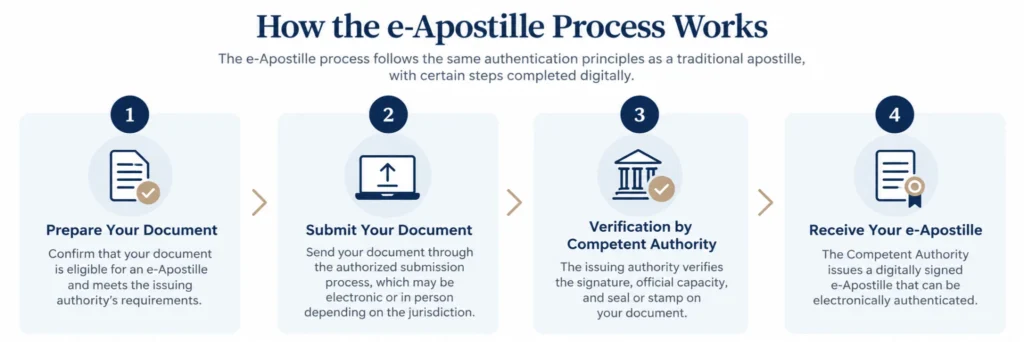
The e-Apostille process follows the same authentication principles as traditional apostilles, but certain steps may be completed digitally. Depending on the issuing authority, businesses may submit eligible documents electronically and receive a digitally signed apostille.
Once the relevant signature, official capacity, and seal or stamp are verified, the Competent Authority issues an e-Apostille that can be electronically authenticated. The HCCH’s guidance on issuing and verifying e-Apostilles explains how digital certificates and electronic signatures support document integrity and verification.
However, procedures vary by jurisdiction. Some authorities offer electronic submission, while others require preliminary certification or additional document preparation. Businesses should confirm these requirements before proceeding.
Why e-Apostilles Matter for International Businesses in 2026
International businesses frequently need authenticated documents when establishing foreign subsidiaries, registering overseas branches, or completing cross-border transactions. Traditionally, these processes often involve mailing documents between companies, government agencies, and authentication authorities.
The HCCH’s electronic Apostille Programme guidance promotes secure electronic issuance and verification, creating opportunities for more efficient document processing.
Where available, e-Apostilles may reduce courier requirements, support digital recordkeeping, and simplify document sharing between international offices. Electronic signatures and verification systems can also strengthen confidence in document authenticity.
The HCCH’s principles and good practices for e-Apostilles emphasize document integrity, secure electronic signatures, and reliable verification.
While these features offer potential efficiencies, processing times and eligibility still depend on the issuing authority and document requirements.
Are e-Apostilles Accepted in Every Country?
A properly issued e-Apostille must be recognized by other Contracting Parties where the Hague Apostille Convention applies. HCCH guidance confirms that an apostille cannot be rejected solely because it was issued electronically.
However, electronic issuance is not available everywhere, and receiving organizations may have different procedures for submitting or verifying digital documents. Businesses should confirm these requirements before requesting authentication.
For countries where the Apostille Convention does not apply, documents may still require traditional government authentication followed by embassy or consular legalization.
Understanding the destination country’s requirements early helps businesses choose the appropriate process and avoid unnecessary delays.
e-Apostilles vs. Traditional Apostilles and Embassy Legalization
Although all three methods support international document authentication, their procedures and applications differ.
Under the Hague Apostille Convention, electronic and traditional apostilles serve the same legal purpose. Embassy or consular legalization generally applies when the Convention does not govern document use between the relevant countries.
The table below summarizes their key differences.
| Authentication Method | How It Works | When It May Be Used |
| e-Apostille | An authorized Competent Authority issues an apostille electronically using a digital signature and applicable security features. | When electronic issuance is available and the Hague Apostille Convention applies between the relevant countries. |
| Traditional Apostille | An authorized Competent Authority issues a paper apostille authenticating the relevant signature, official capacity, and seal or stamp. | For qualifying public documents used between countries where the Hague Apostille Convention applies. |
| Embassy or Consular Legalization | Documents undergo authentication and legalization through applicable government authorities and an embassy or consulate. | Generally when the Hague Apostille Convention does not apply between the relevant countries. |
The appropriate method depends on the document’s origin, destination, and receiving organization’s requirements. Confirming these details before submission can help prevent processing errors and delays.
What Challenges Should Businesses Consider When Using e-Apostilles?
Although e-Apostilles offer potential advantages, availability and procedures differ across jurisdictions. Not every Competent Authority supports electronic issuance, and eligible document types may vary.
The HCCH’s e-Apostille implementation guidance outlines recommended practices for electronic signatures, document integrity, and verification, but individual authorities determine how these systems are implemented.
Businesses must also distinguish between digitally signed documents and officially issued e-Apostilles. A digital signature alone does not constitute an apostille, and scanning a paper apostille does not create an e-Apostille.
Additional notarization, certification, or receiving institution requirements may also apply. Addressing these considerations early helps businesses avoid rejected documents and unnecessary administrative work.
Best Practices for Managing e-Apostilles in 2026
Effective document authentication begins with understanding the destination country’s requirements. Before requesting an e-Apostille, businesses should confirm whether electronic issuance is available and whether the receiving organization can process the document.
Identifying the appropriate Competent Authority is equally important. The HCCH’s directory of Apostille Convention authorities provides information about designated authorities in participating jurisdictions.
Businesses should also verify document eligibility and account for additional notarization, certification, translation, or legalization requirements. Corporate documents such as certificates of incorporation, powers of attorney, and corporate resolutions may require different preparation steps depending on their origin and intended use.
Working with an experienced document authentication provider can help organizations coordinate these requirements and minimize avoidable delays.
Preparing Your Business for the Future of Document Authentication
Electronic apostilles are helping modernize international document authentication by supporting digital processing, secure verification, and more efficient document management.
However, e-Apostilles do not eliminate country-specific requirements or replace traditional apostilles and embassy legalization in every situation. Understanding the appropriate authentication method remains essential for avoiding delays and ensuring documents meet international requirements.
With more than four decades of experience, Washington Consular Services helps companies navigate these complexities through its document authentication services for businesses. From apostilles to embassy legalization, WCS provides knowledgeable guidance and personalized support to help businesses prepare documents for international use.
Key Takeaways
- e-Apostilles simplify document authentication through electronic issuance and verification under the Hague Apostille Convention.
- e-Apostilles have the same legal validity as paper apostilles and cannot be rejected solely because they are electronic.
- Availability varies by jurisdiction, making it important to verify issuing authority and destination requirements.
- Traditional apostilles and embassy legalization remain necessary when electronic issuance is unavailable or the Hague Apostille Convention does not apply.
- Experienced authentication providers like WCS help businesses navigate country-specific requirements and avoid unnecessary delays.