
In the age of digital payments and same-day shipping, the slowest part of international commerce is often still the documents themselves. Not the document transfers, per se, but the trust that must travel with them. A U.S. company can sign a contract in minutes, set up an overseas entity in days, and move talent across borders with surprising speed. Then a government office, a bank, or a local regulator can block or delay market access over the issue of compliance.
Have the required documents been authenticated? If you want your product, agent, or enterprise to be recognized, the applicable documents will need the required stamps.
This is the role of document authentication, the procedural foundation that makes corporate activity abroad possible. Done correctly, these steps help turn a U.S.-issued document into something a foreign authority can accept without dispute. Done wrong, transactions can be delayed, and registrations stalled, triggering costly rework when timelines are tight.
The Difference that Matters
The terminology of document authentication is often confusing to the uninitiated.
Document authentication is an umbrella term covering the two main pillars of compliance: Apostilles and Legalizations.
- Apostille is a streamlined process applicable when two countries—the originating jurisdiction and the destination—are both members of the Hague Apostille Treaty.
- Legalization—also called consular legalization—is a more traditional and cumbersome process that applies when at least one of the two countries is not a Hague signatory.
It has been a long, gradual process since October 5, 1961, when the treaty was drafted, but today there are more than 120 member countries.
Why The World Still Uses “Stamps and Seals”
What surprises many first-time filers is how varied the rules can be. A certificate of good standing might need one pathway for one country and a different pathway for another. Even within the same country, the intended use, such as banking, corporate registration, licensing, or litigation, can change what is required. That variability is why companies often run into trouble at the last mile.
A document can look perfectly fine to the person who drafted it, while still being unacceptable to the receiving authority because the notarization format is wrong, the wrong issuing jurisdiction was used, or a required intermediate step was skipped. This is where document authentication can sometimes feel like a complicated and evasive formality.
The Documents Most Likely to Hold Up a Deal
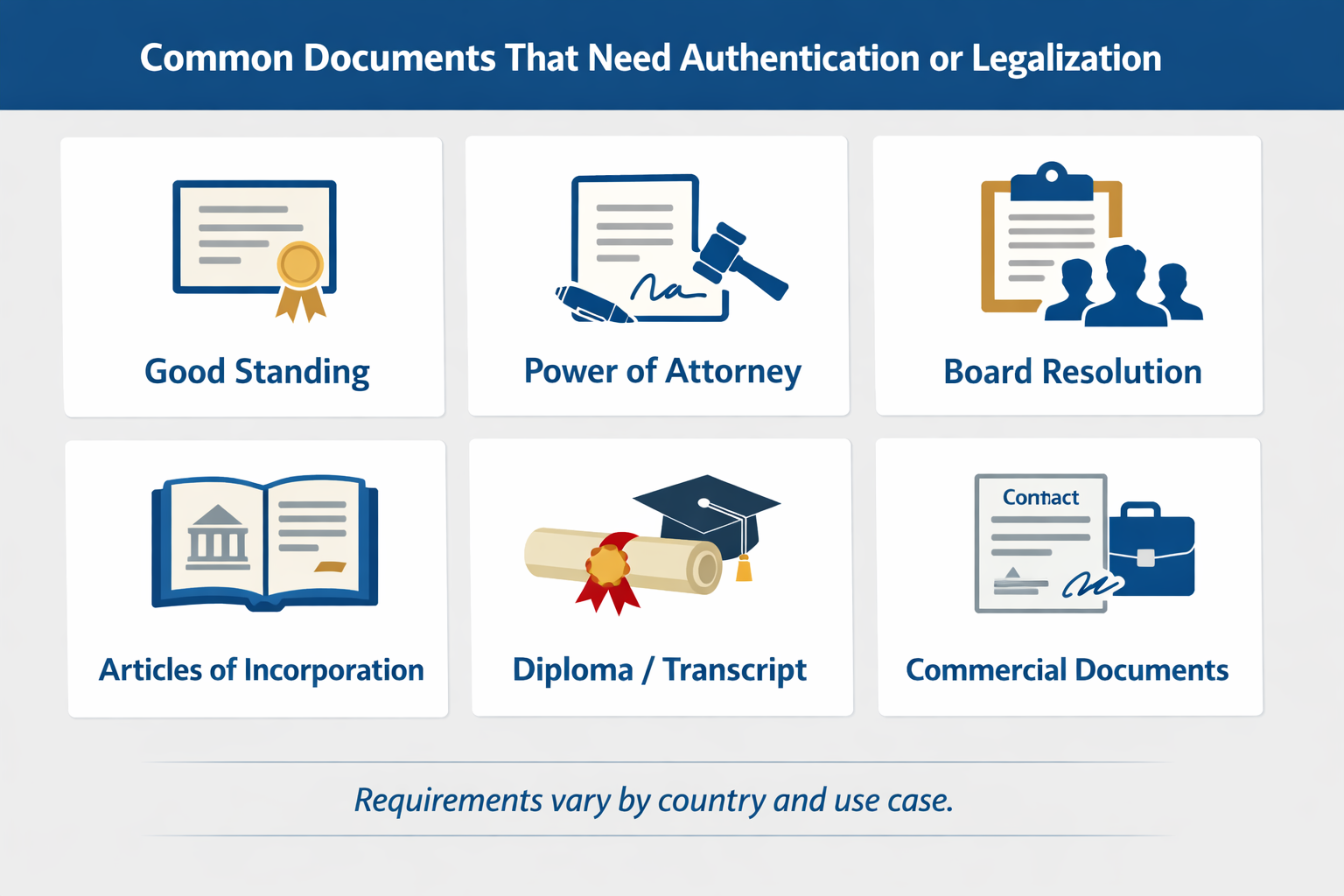
For global businesses, the documents that require authentication cover a broad range: corporate formation documents, health authority certifications, board resolutions, powers of attorney, and materials used to open bank accounts or register an entity abroad. Human resources teams face their own recurring needs, including education credentials and professional records that must be recognized for employment or licensing purposes in another country.
What connects these use cases is compliance. The receiving party, whether a government ministry or a financial institution, must be able to rely on documents without conducting its own investigation into their validity. Apostilles and Consular Legalizations serve as the pillars supporting that trust.
How WCS supports global document authentication
For companies that handle international filings, accuracy and compliance facilitate speed-to-market. WCS supports organizations that conduct global trade through a process designed to assure acceptance, eliminate rework, and keep cross-border activities moving. With 42 years of experience and proximity to embassies and consulates in Washington, D.C., WCS is built for the practical realities of global business, where a single document can make a crucial difference.
WCS includes consulting and end-to-end processing in its provided services, and counts on the long-term loyalty of its portfolio of global brands.