
In many global organizations, International Regulatory Affairs (IRA) teams are expected to move at the speed of product strategy. They are asked to keep submissions on schedule, support renewals and tenders, and coordinate with affiliates across time zones. But the work can stall for a surprising reason: the documents.
For life sciences companies, FDA document authentication is one of the most consequential steps, and it can determine whether a deadline holds or slips.
FDA certificates and supporting documents must be authenticated before they are accepted abroad. That process can involve apostilles, consular legalization, and a sequence of steps that are easy to underestimate. When the workflow is split among multiple vendors and couriers, even routine requests can become hard to track.
What IRA teams often want is not a new process so much as a clearer one: fewer handoffs, more predictable timelines, and a single view of where each document stands.
A bottleneck that can be hard to see
Document authentication is rarely the headline item in a regulatory plan, but it can determine whether the plan holds.
When a Certificate of Pharmaceutical Product (CPP) or a Certificate to Foreign Government (CFG) is required for a submission, renewal, tender, or shipment release, the practical stakes are clear. If authenticated documents do not arrive on time and in the correct format, the next step cannot begin.
Administrative issues, rather than technical issues may cause critical delays:
- Where is the document right now?
- Which steps remain to be completed (state, federal, embassy, or consulate)?
- What is the estimated completion date?
A consolidated approach for FDA export certificate authentication
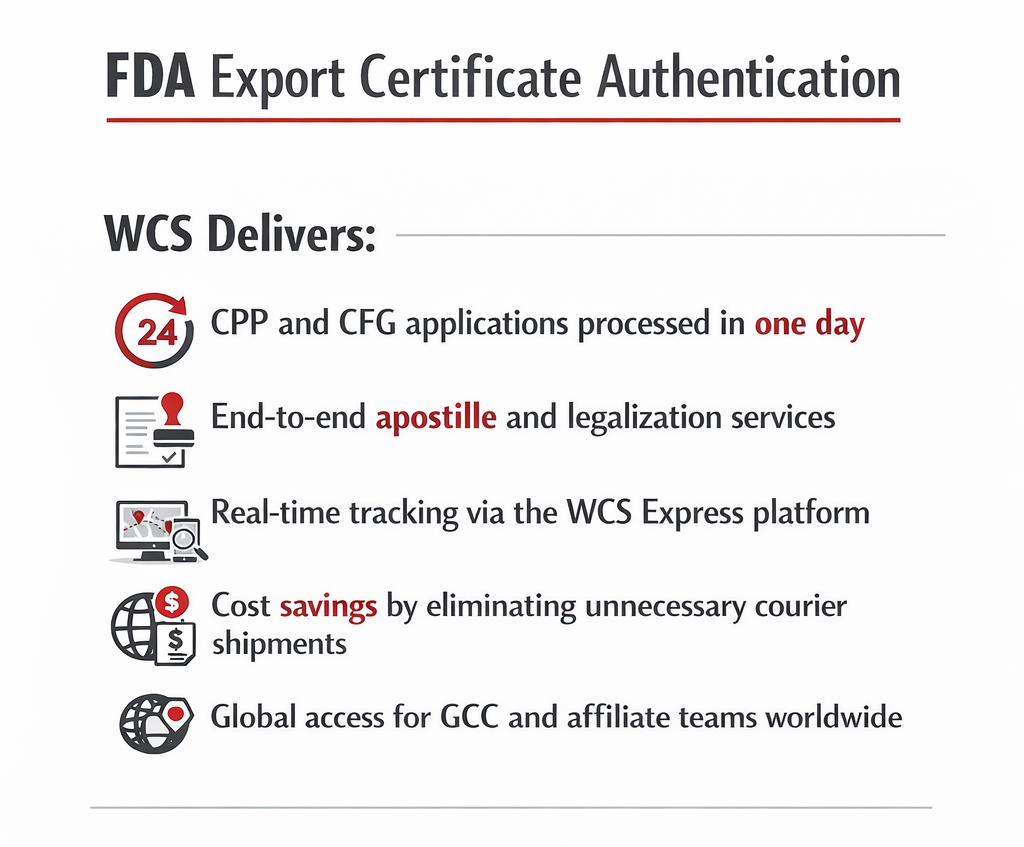
Washington Consular Services (WCS) positions itself as a single partner for complete authenticated certificate, supporting IRA teams from certificate requests through apostille and embassy or consulate legalization, with real-time status tracking through our proprietary digital tool—WCS Express.
For organizations trying to reduce coordination, consolidation can be the solution. When all the steps in the process are brought into one workflow, the coordination burden shrinks.
WCS supports an end-to-end solution, including:
- CPP and CFG support
- Apostille services
- Embassy or consulate legalization
- Real-time tracking through WCS Express
Why visibility matters
In life sciences and other regulated industries, a delay can cascade. Submission windows narrow, renewals can bunch up, and teams can lose the planning cushion that turns a project schedule into a predictable one.
Visibility changes the shape of the problem. In many organizations, the biggest delays don’t start with a single major failure. They start with small unknowns: a document that moved to the next step without notice, a requirement that shifted, a missing signature discovered too late, or a handoff that sat in limbo because no one was sure who owned it.
When teams can see where a document is, what step it is in, and what is expected next, those unknowns become manageable. Status stops being anecdotal and becomes operational. IRA leaders can plan around real dates instead of best guesses, set internal expectations earlier, and intervene while there is still time to correct course.
How teams can benefit
WCS is built on efficient document workflows that combine structured, hands-on processes. In practice, IRA teams depend on timely, compliant outcomes to operate effectively.
- End-to-end status visibility through WCS Express
- Fewer handoffs and fewer courier touchpoints
- More predictable cycle times through consolidated processing
- Clearer planning supported by centralized tracking
- A partner experienced in apostilles and embassy or consulate legalization
Five habits that make the workflow easier
Even with a strong partner, organizations can reduce friction by standardizing how requests enter and move through the system.
- Centralize intake so requests come through one pathway.
- Standardize naming and destination labeling to avoid delays.
- Confirm destination requirements early because apostille and legalization are not interchangeable.
- Set a reporting cadence that relies on system status, not scattered email updates.
- Reduce unnecessary shipping by limiting physical movement where possible.
A process IRA teams can plan around
International Regulatory Affairs teams are asked to deliver predictability in an unpredictable environment. When document authentication is treated as a visible, managed workflow rather than a black box, it becomes easier to plan around.
For organizations looking to streamline workflows from certificate through apostille and legalization, WCS offers an approach centered on consolidation and visibility.
Key takeaways
- FDA export certificate authentication can drive timelines. Treat it as a vital part of the managed workflow.
- Visibility reduces risk. Knowing where a document is and what’s next helps prevent last-minute escalations.
- Destination rules determine the path. Hague countries accept apostille; others require embassy legalization.
- Fewer handoffs reduce delays. Consolidating steps reduce rework.
- Standardization helps global teams. Central intake, consistent naming, and system-based tracking make status easier to share across time zones.
Sources:
Authenticate an official document for use outside the U.S. | USAGov
Types of Export Certificates | FDA
How to Enter a Certificate to Foreign Government (CFG) Application | FDA