
For businesses operating across borders, document requirements can quickly become complicated. A company may need to present corporate records, powers of attorney, certificates, or other official documents in another country when expanding operations, completing a transaction, appointing a representative, or satisfying requirements from a foreign authority.
Before certain U.S. documents can be accepted abroad, they may need to be authenticated, and the process can vary depending on the country where the documents will ultimately be used. The Hague Apostille Convention helps simplify authentication between participating countries by providing a standardized process for qualifying documents.
For businesses, understanding how the Convention works can make it easier to prepare documents correctly, determine the appropriate authentication path, and reduce avoidable complications when conducting business internationally.
What Is the Hague Apostille Convention?
The Hague Apostille Convention established a simplified method for authenticating public documents that will be used between participating countries. Under the Convention, a designated competent authority can issue an apostille that authenticates the origin of a qualifying public document, replacing certain additional legalization steps that may otherwise be required for international use.
For businesses, this distinction can have a direct impact on how corporate documents are prepared and processed. When a qualifying U.S. document will be used in a country covered by the Convention, an apostille may be the appropriate form of authentication. When the destination is not covered by the Convention, the document may need to follow a different authentication and legalization process.
Why the Hague Apostille Convention Matters to International Businesses
Document authentication may appear to be a relatively small administrative requirement, but it can become an important part of an international business activity or transaction. Companies can encounter authentication requirements when establishing operations abroad, submitting corporate records to foreign authorities, appointing representatives, or completing other cross-border business processes.
The Hague Apostille Convention provides a standardized framework that can make authentication more straightforward when the document and destination fall within its scope. This can be particularly useful for companies operating in multiple international markets, where legal, compliance, and administrative teams may be responsible for preparing numerous documents for different jurisdictions.
Understanding whether the Convention applies at the beginning of the process can also help businesses anticipate the steps involved. Instead of treating authentication as an afterthought, companies can incorporate it into their broader document preparation and international business workflows.
What Business Documents May Need an Apostille?
The documents a company needs to authenticate depend on the nature of the transaction, where the documents originated, their intended use, and the requirements of the destination country. Corporate records such as certificates of incorporation, certificates of good standing, articles of incorporation, powers of attorney, board resolutions, notarized corporate documents, and certified copies of certain records may need authentication before they can be presented abroad.
However, a document does not automatically require an apostille simply because it will be used internationally. Businesses should first determine what the receiving organization or foreign authority requires and whether the destination is covered by the Hague Apostille Convention.
The nature of the document itself also matters because different documents can involve different issuing or certifying authorities. Identifying the exact document and its origin before beginning the authentication process can help businesses avoid sending it through an incorrect process.
How Does the Convention Simplify Document Authentication?
Without the framework established by the Hague Apostille Convention, authenticating documents for international use may involve multiple levels of certification and legalization. The Convention simplifies this process between participating countries by establishing the apostille as a standardized certificate recognized under the Convention.
For businesses, this can reduce the number of authentication steps required before a qualifying document can be presented in another participating country. The result is a more standardized process for companies that regularly need to use corporate documents across international borders.
The apostille does not, however, eliminate every document-related requirement. The underlying document must still satisfy the applicable requirements before an apostille can be issued, and the receiving party may have its own requirements concerning the document itself. The Convention therefore simplifies authentication without making every document automatically acceptable for every international purpose.
Hague vs. Non-Hague Countries: Why the Destination Matters
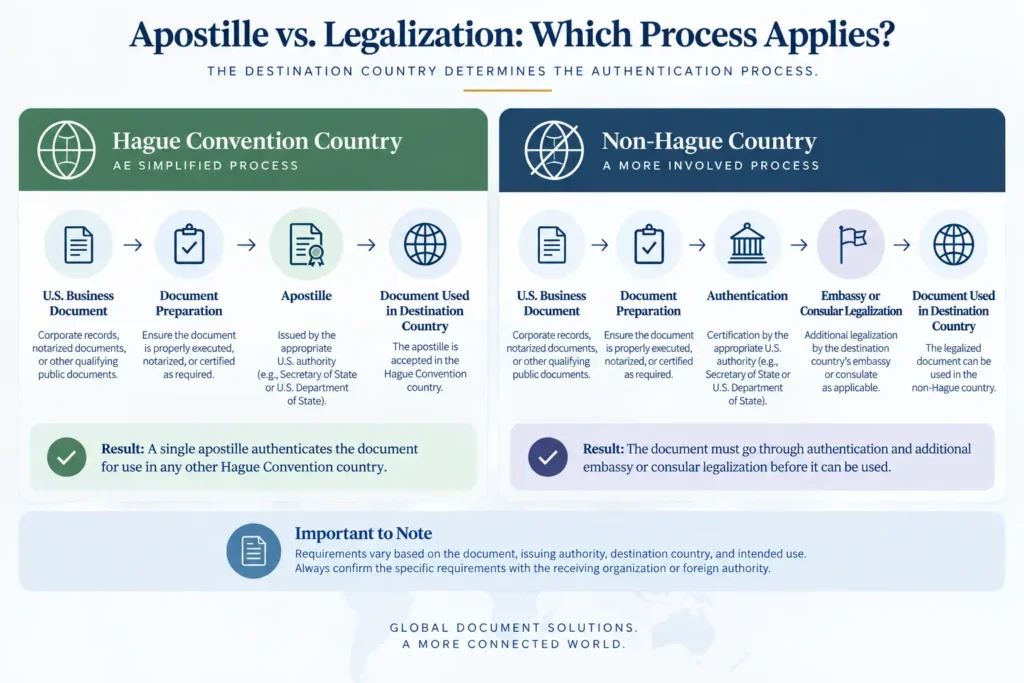
The country where a document will ultimately be used is one of the most important considerations in determining the appropriate authentication process. If the destination is covered by the Hague Apostille Convention and the document qualifies, obtaining an apostille may be the appropriate route.
Documents intended for destinations outside the Convention may require a different process involving authentication and additional legalization procedures. As a result, companies should not assume that documents being sent to several countries can all be processed in the same way.
This becomes especially important for businesses managing international operations across multiple markets. A set of similar corporate documents may require different processing depending on the destination, making it important to identify each document’s final country of use before authentication begins.
Why Businesses Can Still Encounter Authentication Problems
Although the Hague Apostille Convention simplifies part of the authentication process, businesses still need to make sure their documents are properly prepared and submitted to the appropriate authority. The correct procedure can depend on the type of document, whether it is an original, certified copy, or notarized document, the authority connected with the document, and the requirements of the destination.
Preparation problems can create delays before an apostille or legalization can be completed. For example, issues involving notarization, certification, or the form of the document may need to be addressed before the document can proceed through the appropriate authentication process.
These complications can be particularly significant when documents are connected to transaction deadlines, overseas registrations, or other time-sensitive business activities. Determining the authentication requirements early gives companies more opportunity to identify potential issues before they interfere with broader international plans.
Managing Authentication Across Multiple Countries
International document authentication can become increasingly complex as a company expands into more jurisdictions. Legal departments, corporate secretaries, compliance teams, and administrative professionals may need to coordinate different documents, destinations, requirements, and deadlines at the same time.
A document destined for one country may qualify for an apostille under the Hague Apostille Convention, while a similar document being sent elsewhere may require a different legalization process. Differences in document type, issuing authority, and destination requirements can add another layer of complexity when companies are processing documents in volume.
For businesses with ongoing international authentication needs, the process can therefore become an operational workflow rather than an occasional administrative task. Establishing a consistent approach to identifying documents, destinations, and authentication requirements can help companies manage that workflow more effectively.
Preparing Business Documents for International Use
Businesses can reduce potential complications by establishing several important details before beginning the authentication process. They should identify the exact document being requested, determine where it was issued, confirm where it will ultimately be used, and understand any instructions provided by the receiving organization or foreign authority.
These details help determine whether an apostille or another form of authentication and legalization may be required. They can also help identify whether a document needs additional preparation before it can proceed through the authentication process.
Companies managing multiple documents may benefit from reviewing the entire group before processing begins. Looking at the documents collectively can make it easier to identify different authentication paths and address potential issues before they create delays later in the process.
How WCS Helps Businesses With Apostilles and Document Legalization
For more than 40 years, Washington Consular Services (WCS) has helped businesses navigate document authentication for international use. WCS provides high-touch apostille and document legalization services to companies of all sizes across diverse industries, helping clients manage the requirements associated with preparing documents for use abroad.
Whether a company needs an apostille for a corporate document or must navigate legalization requirements for a non-Hague destination, determining the appropriate process before documents are submitted can help reduce unnecessary complications. WCS works with businesses to understand their documents and destinations and help them navigate the authentication process efficiently.
Key Takeaways
- The Hague Apostille Convention simplifies the authentication of qualifying documents for use between participating countries.
- Businesses may need apostilles for corporate documents such as certificates of good standing, powers of attorney, and incorporation records.
- The destination country helps determine whether a document requires an apostille or another legalization process.
- Proper document preparation can help businesses avoid authentication delays and unnecessary processing issues.
- Companies operating across multiple countries may need to manage different authentication requirements for each destination.