
Business professionals reviewing official documents in a corporate meeting, representing the apostille process for business documents, international document authentication, legal compliance, and global business expansion.

What to Expect When Getting an Apostille for Business Documents

Expanding internationally often requires more than contracts and business registrations. Companies operating across borders are frequently asked to provide authenticated corporate documents before they can open overseas offices, complete transactions, establish partnerships, or comply with foreign regulations.

For businesses unfamiliar with international document authentication, understanding what to expect when getting an apostille can help prevent delays, rejected filings, and costly disruptions. The apostille process can feel complicated at first, but knowing the required steps ahead of time helps businesses move through international requirements more efficiently.

What Is an Apostille?

An apostille is an official certificate issued by a designated government authority that verifies the authenticity of a document for use in another country.

The apostille confirms:

  • The legitimacy of the signature
  • The authority of the official signing the document
  • The authenticity of the seal or stamp on the document

Apostilles are accepted between countries that are members of the Hague Apostille Convention. Once a document receives an apostille, it can generally be used internationally without additional embassy or consular legalization.

Why Businesses Need Corporate Apostilles

Companies may need apostilled documents for a wide range of international activities, including:

  • Opening foreign subsidiaries or branch offices
  • Establishing international banking relationships
  • Completing overseas mergers and acquisitions
  • Participating in global tenders or contracts
  • Registering products abroad
  • Hiring international employees
  • Complying with foreign regulatory requirements

Understanding what to expect when getting an apostille is especially important because foreign governments and institutions may reject improperly authenticated documents entirely.

Common Business Documents That Require Apostilles

Businesses often need apostilles for:

  • Certificates of Incorporation
  • Articles of Organization
  • Certificates of Good Standing
  • Board Resolutions
  • Powers of Attorney
  • Commercial Invoices
  • IRS Documents
  • Trademark and Patent Documents
  • Corporate Agreements
  • Business Licenses

The exact requirements vary depending on the destination country and intended use of the documents.

What to Expect When Getting an Apostille for Corporate Documents

Infographic explaining what to expect when getting an apostille for business documents, including document review, notarization, submission to authorities, apostille issuance, and international authentication for corporate use.

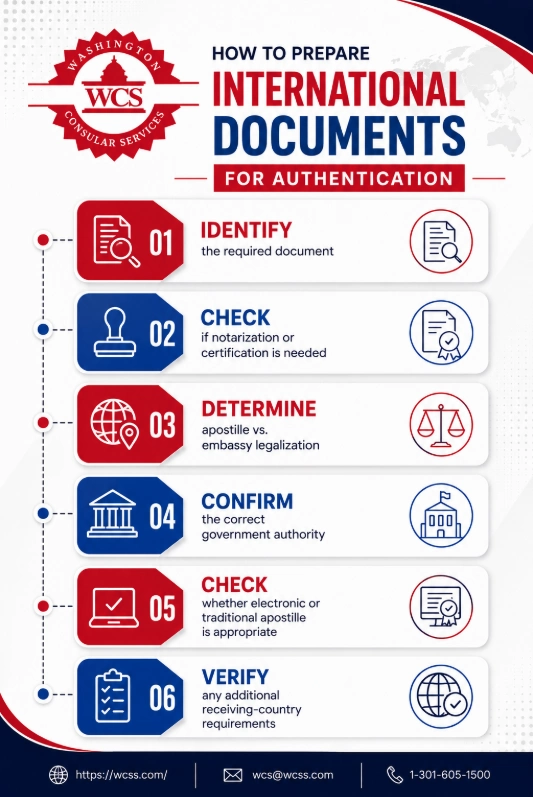
The apostille process varies depending on the document type and destination country, but most businesses can expect several key steps. Knowing what to expect when getting an apostille ahead of time can help organizations avoid unnecessary delays.

  1. Document Review and Preparation
  • Before submitting documents, businesses should confirm:
  • Which documents require authentication
  • Whether notarization is necessary
  • Which country will receive the documents
  • Whether apostille or embassy legalization is required

Improperly prepared documents are one of the most common causes of rejection. This is one reason why businesses researching what to expect when getting an apostille often seek professional guidance early in the process.

  1. Notarization or Certification

Many business documents must first be notarized or certified by the appropriate issuing authority before they can receive an apostille.

For example:

  • Corporate agreements may require notarization
  • Certified copies may need to be issued by a state agency
  • Federal documents may require certification from the originating department

Requirements vary by document type and jurisdiction.

  1. Submission to the Appropriate Authority

Once prepared, documents are submitted to the designated authority responsible for issuing apostilles.

This may include:

  • The Secretary of State for state-issued documents
  • The U.S. Department of State for certain federal documents

Processing times can vary depending on workload, document type, and jurisdiction. Businesses learning what to expect when getting an apostille should also plan for potential delays during peak processing periods.

  1. Apostille Issuance

After verification, the apostille certificate is attached to the document. The document is then recognized for legal use in Hague Convention countries.

At this stage, businesses should carefully review the completed apostille to ensure all information is accurate before international submission.

Apostille vs. Embassy Legalization

One of the most important things businesses should expect is determining whether an apostille is actually sufficient.

Apostilles only apply to countries that participate in the Hague Apostille Convention.

If the destination country is not a Hague member, businesses typically need embassy or consular legalization instead. This process often involves multiple authentication steps through:

  • State agencies
  • The U.S. Department of State
  • The foreign embassy or consulate

Embassy legalization usually takes longer and involves additional requirements. Companies researching what to expect when getting an apostille should confirm destination-country requirements before starting the process.

Common Challenges Businesses Encounter

International document authentication can quickly become complicated. Businesses often encounter issues such as:

  • Incorrect notarization
  • Missing certifications
  • Country-specific formatting requirements
  • Tight international deadlines
  • Embassy processing delays
  • Rejected documents due to technical errors

Even small mistakes can delay overseas operations, banking approvals, or contract execution.

How Long Does the Apostille Process Take?

Turnaround times depend on several factors, including:

  • The type of document
  • The issuing state or federal agency
  • Destination country requirements
  • Whether embassy legalization is required
  • Current government processing volumes

Some apostilles can be completed quickly, while others may take several weeks if multiple agencies are involved.

Businesses working under strict international deadlines should plan ahead whenever possible. Understanding what to expect when getting an apostille can help companies build more realistic timelines for global transactions and compliance needs.

Why Businesses Use Professional Apostille Services

Because international authentication requirements vary widely, many companies rely on professional apostille providers to manage the process efficiently.

Professional services help businesses:

  • Navigate country-specific requirements
  • Avoid processing errors
  • Reduce delays and rejections
  • Coordinate federal and embassy procedures
  • Accelerate turnaround times
  • Ensure compliance with international standards

With decades of experience and close proximity to embassies in Washington, D.C., Washington Consular Services (WCS)⁠ helps organizations streamline complex authentication processes with dependable, high-touch support.

Key Takeaways

  • Apostilles authenticate business documents for international use in Hague Apostille Convention countries.
  • Businesses commonly need apostilles for expansion, banking, contracts, compliance, and overseas transactions.
  • Understanding what to expect when getting an apostille helps companies avoid delays and rejected filings.
  • The process typically involves document preparation, notarization or certification, submission to the proper authority, and apostille issuance.
  • Requirements vary depending on the document type and destination country.
  • Businesses should confirm whether apostille or embassy legalization is required before submitting documents internationally.
  • Mistakes in notarization, formatting, or certifications can lead to rejected documents and costly delays.
  • Professional apostille services help companies navigate complex international authentication requirements more efficiently.
  • Washington Consular Services (WCS) provides dependable corporate document authentication support backed by decades of experience.

WCS Attends RAPS Euro Convergence, in Lisbon, Portugal

Returning from the RAPS Euro Convergence, in Lisbon, Portugal, we have several takeaways to share with you about the state of regulatory affairs, as concerns Pharma and Medical Devices in the European Union.

AI, as expected, took center stage as a primary topic of discussion, with workshop presenters and audience alike addressing the opportunities and challenges of this rapidly growing technology. How does AI fit into data collection, analysis, trials, safety control, product registrations, and every other aspect of health-care delivery?

The lingering concern among many, inside and outside of regulatory affairs—that AI will replace, at an accelerating rate, the role of people in productive activities—was largely dispelled. Rather the vital interaction between professionals and their technology tools was confirmed in many Q&A settings at the conference.

The move to further efficiencies, digitization, data storage, and information sharing was top-of-mind. 

Another priority topic was the balance between speed-and accessibility for patients of newly registered products, on the one hand, versus the imperative for safety-control in the approval process. In this vein, there were numerous exchanges between representatives of the European Medical Agency and of industry. 

The conference was filled with service providers specialized in digitized RA consulting, including approvals processing, after-market management, and the rapidly growing field of regulatory intelligence. WCS was able to emphasize the key and oft-neglected role of document-authentication—the final step in delivering products to overseas markets.

We spoke to RA support companies that reported regularly receiving clients’ documents with missing apostille stamps. These clients had the misunderstanding that the apostilles were unnecessary because they contained QR codes. Health authorities rejected these documents, and valuable time was lost while the documents were prepared again with the required stamps and authorizations.

As WCS continues to expand its global footprint, with affiliate services around the globe, we are grateful for the contacts made and the knowledge gained at Euro Convergence. In an increasingly global market, EU perspectives and EU regulations are of invaluable importance to the work we do on behalf of the Medical Device and Pharmaceutical communities.


wcss-logo-red-1

Varghese George, CEO

Mitchell Torton, Director

Washington Consular Services

Metro Washington, DC, USA

WCS@WCSS.com | www.wcss.com

Tel. USA 301 605 1500

Business partners shaking hands after signing legal documents for apostille and embassy legalization services.

Apostille or Legalization: What kind of document authentication do I need?

When preparing documents for international use, one of the most common questions businesses face is what type of document authentication is needed. Choosing the correct process is essential. Selecting the wrong path can lead to rejected documents, delays, and additional costs.

In many cases, the confusion comes from a third component: embassy legalization. Understanding how all three elements work together is key to ensuring documents are accepted abroad.

For organizations managing cross-border operations, these distinctions are more than procedural details. Document authentication directly impacts timelines for international expansion, contract execution, regulatory approvals, and global compliance. Having a clear understanding of when each method applies helps businesses avoid disruptions and move forward with confidence in international markets.

What Is an Apostille?

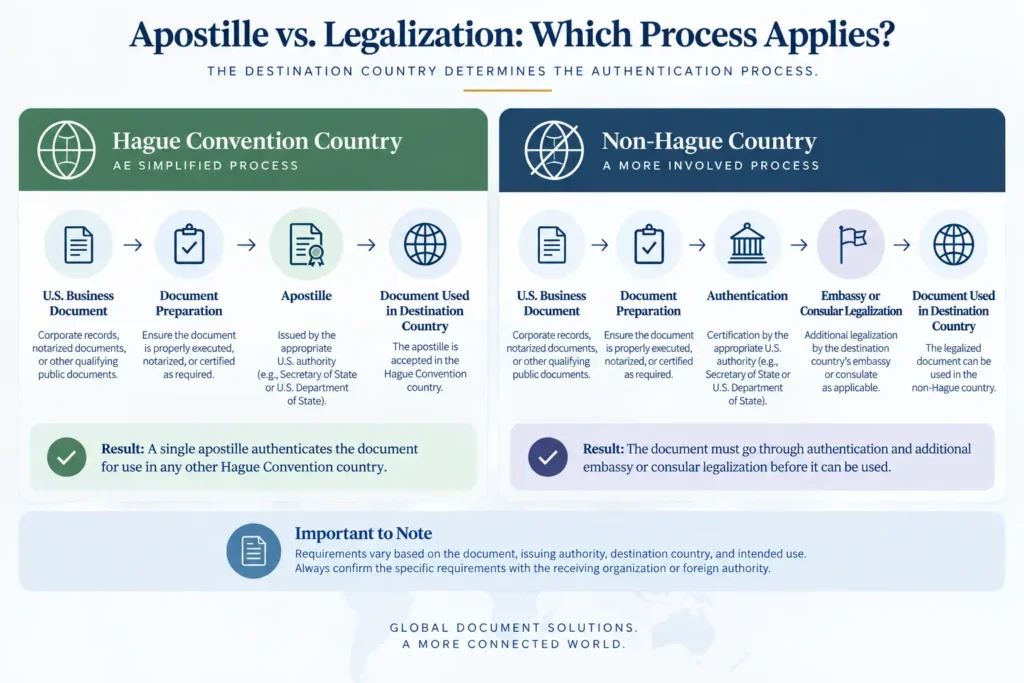
An apostille is a simplified form of document authentication used for countries that are members of the Hague Apostille Convention. It certifies the authenticity of a public official’s signature, seal, or stamp on a document.

Apostilles are typically issued at the state level for documents such as:

  • Corporate records
  • Notarized agreements
  • Vital records
  • Powers of attorney

Once an apostille is issued, the document can be used directly in any Hague Convention country without further steps.

What Is the US Department of State Authentication?

US Department of State authentication is a federal certification step used for documents intended for countries that are not part of the Hague Apostille Convention.

It verifies the authority of the state official who authenticated the document and prepares it for the next stage, which is embassy legalization.

What Is Embassy Legalization?

Embassy legalization is the final step required for documents being used in non-Hague countries.

This process is handled by the destination country’s embassy or consulate and confirms that the document is valid for use within that specific jurisdiction.

Embassy legalization is country-specific, meaning requirements, processing times, and procedures can vary significantly depending on the destination.

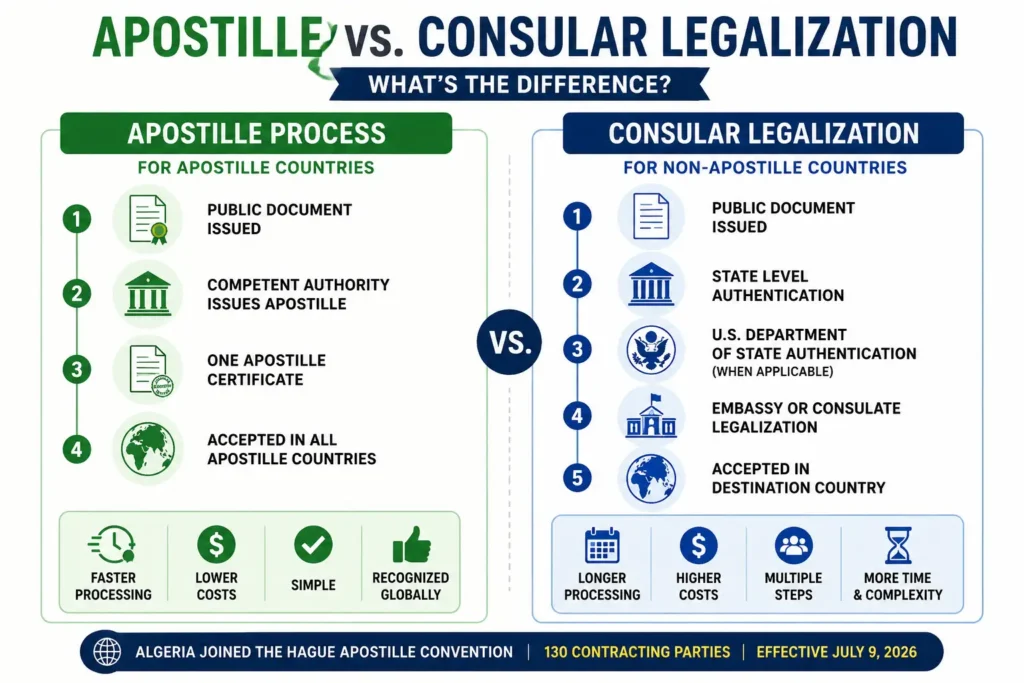
How Apostille, Authentication, and Legalization Work Together

The correct process depends entirely on the destination country:

For Hague Convention Countries

  • Apostille is the only step required
  • No embassy legalization is needed

For Non-Hague Countries

Documents must go through a multi-step process:

  1. Notarization or document issuance
  2. State authentication
  3. US Department of State authentication
  4. Embassy legalization

Each step builds on the previous one to ensure the document is fully validated for international use.

Key Differences Between Apostille and Authentication

Comparison chart showing apostille vs authentication and embassy legalization processes for Hague and non-Hague countries.

Geographic Applicability

  • Apostille applies to Hague Convention countries
  • Authentication and legalization apply to non-Hague countries

Process Complexity

  • Apostille is a single-step process
  • Authentication requires multiple steps, including embassy legalization

Final Validation

  • Apostille is the final certification for Hague countries
  • Embassy legalization is the final approval for non-Hague countries

How to Determine Which Process You Need

Guide explaining how to choose between apostille and authentication legalization for international document use.

1. Identify the Destination Country

Identifying the destination country is the most critical step in determining the correct document authentication process. The requirements vary depending on whether the country is a member of the Hague Apostille Convention. If the destination country is part of the Hague Convention, an apostille is sufficient. However, if the country is not a member, the document must go through a more involved process that includes authentication and embassy legalization. 

2. Review Specific Requirements

It is essential to review the specific requirements of the destination country before proceeding. Each country may have its own rules regarding document formatting, notarization, and any additional supporting materials that must be submitted. Understanding these requirements in advance helps prevent delays and ensures that documents are processed correctly the first time. 

3. Understand the Full Process

Having a clear understanding of the full authentication process is especially important for non-Hague countries. In these cases, completing authentication through the U.S. Department of State is only one step in the process. Embassy legalization is typically required afterward for the document to be fully recognized and accepted in the destination country.

Common Mistakes to Avoid

  • Assuming authentication and legalization are the same
  • Skipping the embassy legalization step for non-Hague countries
  • Using an apostille for a country that does not accept it
  • Submitting documents that are not properly notarized or certified

These errors often result in delays and resubmissions.

Why This Distinction Matters for Businesses

For organizations operating across borders, document authentication is directly tied to compliance and operational timelines.

Understanding when embassy legalization is required helps:

  • Prevent rejected documents
  • Avoid unnecessary delays
  • Ensure acceptance by foreign authorities
  • Support efficient international operations

For businesses managing these requirements regularly, working with an experienced provider such as Washington Consular Services can help ensure documents are handled accurately and move through each stage of the process efficiently.

Key Takeaways

  • An apostille is used for Hague Convention countries and requires only one step
  • US Department of State authentication is part of a multi-step process for non-Hague countries
  • Embassy legalization is the final step for documents going to non-Hague countries
  • The destination country determines which process is required
  • Apostilles are generally faster, while authentication and legalization take more time
  • Skipping embassy legalization for non-Hague countries will likely result in rejection
  • Understanding the full process helps businesses avoid delays and compliance issues
Moving Abroad After Graduation A Guide to Document Authentication for Studying Abroad

Moving Abroad After Graduation? A Guide to Document Authentication for Studying Abroad

Graduating is a major milestone. For many students and recent alumni, it is also the beginning of a new chapter abroad. Whether you are applying for a job in another country, enrolling in graduate school overseas, pursuing a visa, or relocating for personal reasons, one detail can quickly become a roadblock: your documents may need to be officially authenticated before they will be accepted internationally.

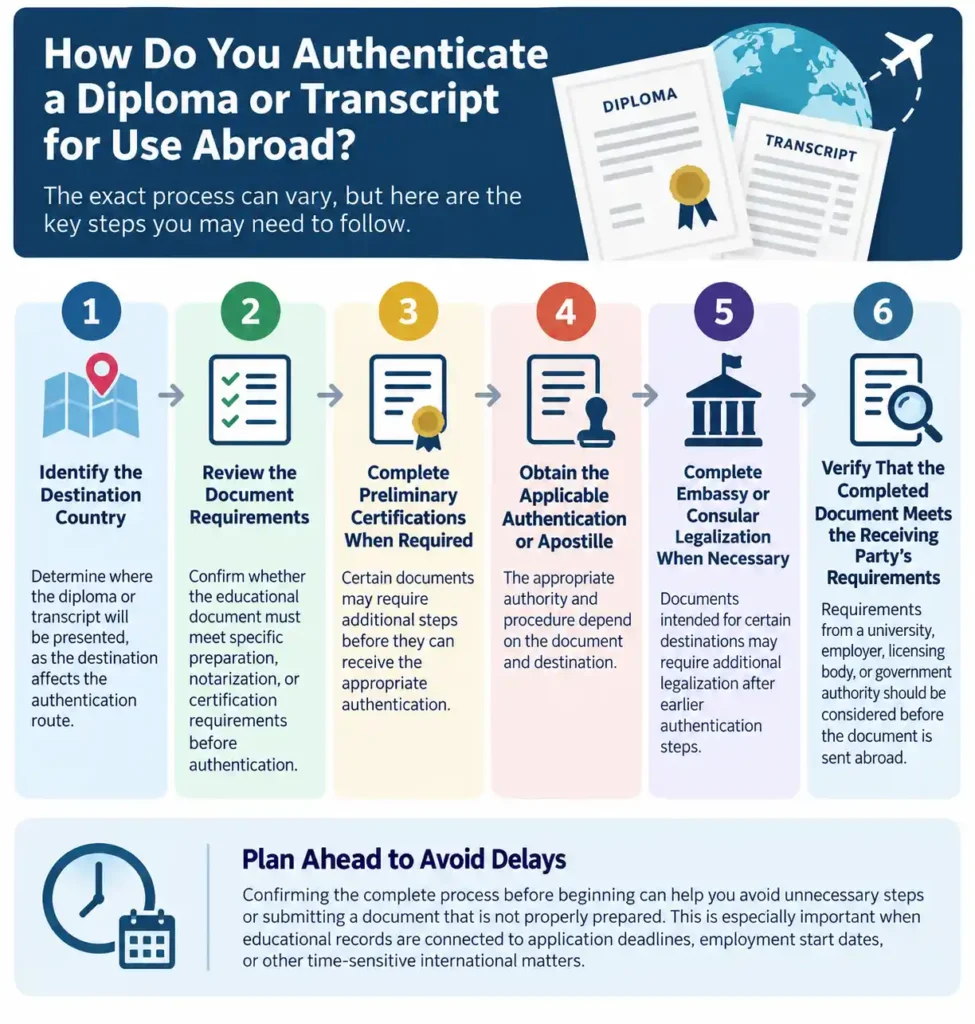
Understanding the document authentication process early can help students avoid delays, rejections, and last-minute stress. Depending on the destination country and document type, this may involve an apostille or embassy legalization so the documents can be used internationally.

Why document authentication matters when moving abroad

Many countries require official U.S. documents to go through an apostille or embassy legalization process before they can be used overseas. This is especially important when it comes to document authentication for studying abroad, since foreign universities, employers, immigration offices, and government agencies may reject documents that have not been properly authenticated.

This can affect important life plans such as:

  • Applying for a work visa
  • Accepting an international job offer
  • Enrolling in a graduate or professional school abroad
  • Completing immigration paperwork
  • Meeting employer onboarding requirements
  • Supporting residency or relocation applications

When deadlines are tight, even a small documentation issue can create costly setbacks. That is why it is important to understand the process early and work with a trusted provider that knows how to get it done right the first time.

What is an apostille or embassy legalization?

An apostille is a form of authentication used for documents going to countries that participate in the Hague Apostille Convention. Embassy legalization is typically required for countries that are not part of that convention and involves additional steps.

The correct process depends on several factors, including:

  • The type of document
  • The state where it was issued
  • Whether federal authentication is required
  • The destination country’s rules

Because requirements can vary, many students and alumni turn to experienced professionals to help ensure their documents are prepared and submitted properly.

Documents WCS helps process for studying abroad

WCS assists with many of the documents commonly needed for international education, employment, and relocation. These include:

Diploma

A diploma may be required by foreign employers, universities, licensing boards, or immigration authorities as proof of completed education.

Transcript

Official transcripts are often requested for graduate school admissions, credential evaluations, and professional registration abroad.

Enrollment Letter

Students applying for exchange programs, internships, visa extensions, or academic opportunities overseas may need an authenticated enrollment verification letter.

Police Record or Clearance

Some countries require a police clearance as part of visa, residency, or background screening applications.

FBI Background Check

For federal-level background verification, an FBI background check may need apostille or authentication before submission abroad.

Birth Certificate

Birth certificates are commonly requested for visa applications, dual citizenship matters, family sponsorship, and civil registration processes in another country.

Power of Attorney

A power of attorney may be needed when authorizing someone to act on your behalf for legal, financial, or personal matters while you are overseas.

A simple 3-step process

WCS makes the authentication process straightforward:

Moving Abroad After Graduation A Guide to Document Authentication for Studying Abroad

1. Send your document to WCS

Clients begin by submitting the document that needs to be processed. WCS reviews the request and helps guide the next steps.

2. WCS obtains the apostille or embassy legalization

WCS handles the authentication process based on the document type and destination country requirements.

3. Receive your document ready for international use

Once processing is complete, your authenticated document is returned so it can be used abroad.

This streamlined approach helps reduce confusion and gives clients confidence that their documents are being handled by a team with deep experience in apostille and legalization services.

Why students and alumni choose WCS

When preparing for international education or relocation, reliability matters. WCS is trusted by clients who need document authentication for studying abroad handled accurately and professionally.

Fast processing

International applications often run on strict timelines. WCS helps clients move quickly so they can stay on schedule.

Expertise in state and federal apostilles

Some documents require state-level authentication, while others require federal processing. WCS understands these distinctions and helps direct each document through the proper channels.

Embassy legalization in Washington, D.C.

For countries that require embassy legalization, WCS offers experience handling the additional steps involved in Washington, D.C.

Accurate processing to help avoid rejections

Errors in authentication can lead to delays, resubmissions, or rejected applications. WCS focuses on getting documents processed correctly the first time.

Secure document handling and international shipping

Original personal documents often carry high importance. WCS emphasizes careful handling and secure delivery throughout the process.

Who can benefit from these services?

While this flyer speaks directly to students and alumni, the need for document authentication often extends to a wider group of international movers and applicants. WCS may be especially helpful for:

  • Recent graduates accepting jobs abroad
  • Students admitted to foreign universities or graduate programs
  • Alumni applying for teaching, research, or fellowship opportunities overseas
  • Individuals completing visa or residency applications
  • Families relocating internationally
  • Professionals needing background checks, civil records, or legal documents authenticated for use overseas

Avoid delays before your move

One of the biggest mistakes applicants make is waiting too long to address document requirements. International employers, universities, and government agencies may not process an application until the required documents are fully authenticated.

Planning ahead can help you avoid:

  • Missed admissions or job deadlines
  • Visa processing delays
  • Additional shipping or resubmission costs
  • Rejected documents due to incorrect authentication

Starting early gives you time to confirm what is required and complete the process without unnecessary stress.

Get started with WCS

If you are preparing for international education or relocation, WCS can help make sure your U.S. documents are ready for international use. From diplomas and transcripts to FBI background checks and birth certificates, WCS provides dependable support for document authentication for studying abroad, apostille services, and embassy legalization backed by more than four decades of experience.

Whether you are preparing for graduate school, a new career opportunity, or an international relocation, having your documents authenticated correctly is an important step toward a smoother transition.

Trusted experts in apostille and legalization, WCS helps clients get it done correctly the first time. Contact us today to get started.

Key Takeaways

  • Studying or moving abroad often requires U.S. documents to be officially authenticated.
  • Diplomas, transcripts, birth certificates, and background checks may need an apostille or embassy legalization.
  • Document requirements vary based on the document type and destination country.
  • Incorrectly processed documents can lead to delays, rejections, and missed deadlines.
  • WCS helps students, alumni, and other international applicants get documents processed correctly.
  • With 40+ years of experience, WCS offers dependable support for state, federal, and embassy legalization needs.
  • Starting early can help reduce stress and keep your education or relocation plans on track.
Top Countries for Pharmaceutical and Medical Device Manufacturing

Manufacturing Shifts in Life Sciences: Top Countries for Pharmaceutical and Medical Device Manufacturing

A new map for manufacturing

In Pharmaceutical and medical device manufacturing, the United States and parts of Europe remain centers for high-value production, while China and India continue rapid scale-up. At the same time, smaller hubs — from Ireland to Singapore — are attracting disproportionate investment for specialized capacity, favorable tax regimes, skilled labor and fast turnaround. Yet despite advances in automation, clean-room engineering and cold-chain logistics, executives say the biggest bottlenecks in new builds and cross-border production are often administrative: permits, approvals and paperwork.

Top countries for pharma manufacturing

United States

The United States continues to anchor advanced pharmaceutical manufacturing, particularly for complex products where talent, quality systems, and regulatory maturity matter.

Source: Grand View Research (U.S. biologics manufacturing outlook)

Germany

Germany is frequently cited as a leading pharmaceutical producer and exporter, supported by a deep industrial base and strong manufacturing infrastructure.

Source: Germany Trade and Invest (Pharmaceutical industry in Germany)

Switzerland

Switzerland’s Basel region remains one of the world’s best-known life sciences clusters, supporting high-value manufacturing and a dense ecosystem of suppliers and expertise.

Source: Canton of Basel-Stadt (Industry and companies overview)

Ireland

Ireland has developed into a major export-oriented pharmaceutical manufacturing center, with a strong multinational presence and a mature life sciences workforce.

Source: IDA Ireland (Pharmaceutical manufacturing in Ireland)

India

India continues to expand its role as a global pharmaceutical manufacturing hub, especially in large-scale production and cost-competitive supply.

Source: Industry overview (MedXDRG global pharma location summary)

Singapore

Singapore has positioned itself as a global biopharma hub, emphasizing advanced manufacturing capacity, investment readiness, and specialized talent.

Source: Singapore Economic Development Board (Biotech and pharmaceuticals)

Top countries for medical device manufacturing

United States

The United States remains a leading center for medical device manufacturing, spanning both high-end innovation and scaled production.

Source: Electronic Manufacturing Service (Where most medical devices are manufactured)

Germany

Germany’s reputation for precision engineering and dense medtech clustering continues to make it a key location for device production.

Source: Alpha Sophia (Leading medical device companies by country)

China

China remains a major device manufacturing center, particularly for high-volume production categories supported by broad supplier density.

Source: Electronic Manufacturing Service (Where most medical devices are manufactured)

Mexico

Mexico’s device manufacturing footprint has grown alongside nearshoring, with clusters that support North American supply chains and quick turnaround.

Source: Tijuana EDC (Medical device cluster overview)

Costa Rica

Costa Rica has built an export-oriented medical device industry recognized as a significant global producer and exporter.

Source: U.S. International Trade Commission (Costa Rica medical devices executive briefing)

Japan

Japan remains a major medical device market and manufacturing base, supported by a large and organized industry presence.

Source: International Trade Administration (Japan medical devices country commercial guide)

South Korea

South Korea continues to invest in and expand its medical device industry, supported by coordinated industry development efforts.

Source: Medical Korea / KHIDI (Industry development overview)

The overlooked constraint: documents that must travel before products can

When companies establish overseas operations, register products, authorize distributors, or move regulated goods internationally, they often face country-specific requirements for document acceptance. Corporate papers, powers of attorney, quality certificates, and trade documents can become gating items.

A common point of friction is timing. Quality and regulatory teams may be ready, facilities may be validated, and commercial plans may be set, but a missing authentication step can delay the onboarding process with a local partner.

“Manufacturing decisions are global, but compliance is local,” one operations director said. “And local rules tend to be unforgiving.”

How certificate authentication fits into global production

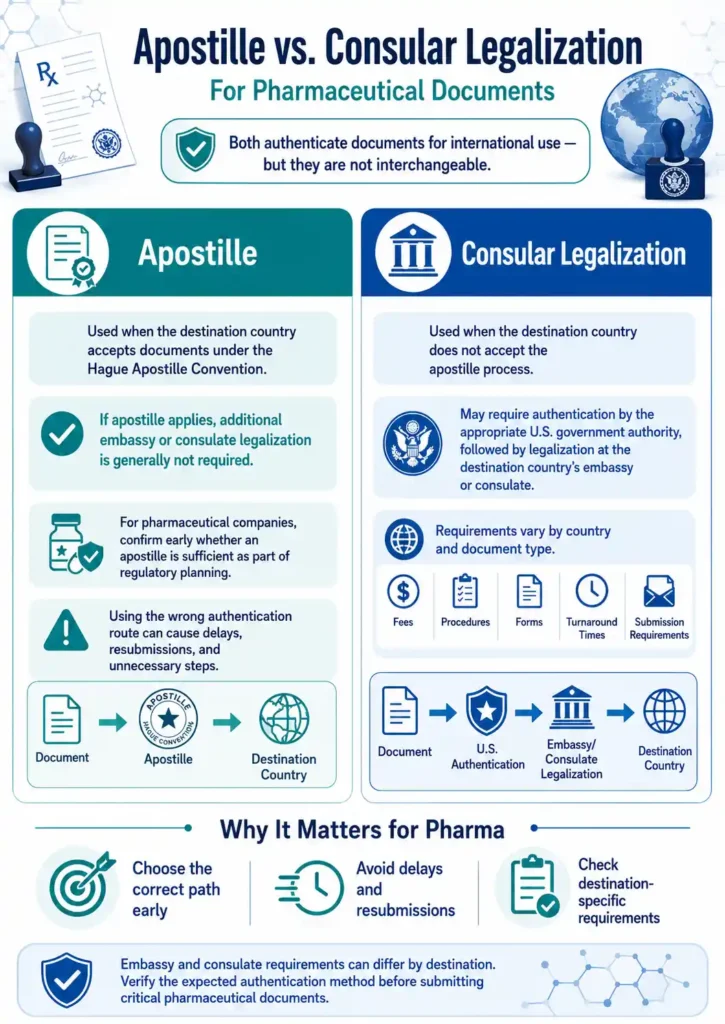
For U.S.-manufactured or marketed products, expanding into global markets requires authenticated documentation to support product registration in each target country. Local operating companies must submit these documents — bearing either an apostille (for Hague Convention countries) or full embassy legalization (for non-Hague countries) — to their respective health authorities as part of the registration process. These submissions are often time-bound, making the timely delivery of authenticated documents critical to ensuring business continuity. If these documents are not submitted on schedule, global product launches can be delayed, shipments can be held at customs, and the entire supply chain can be disrupted.

Top Countries for Pharmaceutical and Medical Device Manufacturing

Certificates of Pharmaceutical Product (CPP)  and Certificate to Foreign Government (CFG)

The FDA’s move to issuing electronic export certificates -electronic CPP (eCPP)and electronic CFG(eCFG)changed the mechanics, but not the need for authentication.  

What that typically looks like operationally:

  • Your team downloads the eCPP/eCFG from the FDA portal.
  • The document is transmitted to your legalization partner in digital form.
  • It is printed and prepared for federal authentication steps, then routed through any required embassy legalization.

How WCS supports these certificate workflows

Washington Consular Services (WCS) streamlines the entire export certificate process, from application through legalization or apostille, ensuring minimal turnaround time for our clients.

We can apply for an Export Certificate in one of two ways: as an authorized agent on behalf of the company, or directly through the company’s FDA account. This flexibility allows us to adapt to each client’s preferred setup and internal processes.

Once we receive a request for an export certificate, we process and submit the application to the FDA on the same day. Upon receiving the digital copy from the FDA, we immediately proceed with legalization and apostille — again, on the same day. This same-day, end-to-end approach eliminates unnecessary delays and ensures that product registrations and international filings stay on track.

If your team needs help authenticating business, regulatory, or trade documents for international use, Washington Consular Services (WCS) can support apostille and embassy legalization workflows to help keep cross-border timelines on track.

Key takeaways

  • The top countries for pharmaceutical and medical device manufacturing combine scale, specialization, and regulatory readiness.
  • Pharma and device manufacturing are concentrating in a mix of large markets and specialized hubs.
  • The United States and Germany remain anchors for high-value, regulated production.
  • China and India continue to scale, especially for volume and supply-chain depth.
  • Ireland and Singapore draw investment for export-oriented and advanced manufacturing environments.
  • Mexico and Costa Rica stand out in devices for nearshoring and established medtech clusters.
  • Cross-border timelines often hinge on document readiness, not factory readiness.

Source links

Submit a Request is now WCS Express -Get Started with your order now!