
Expanding internationally often requires more than contracts and business registrations. Companies operating across borders are frequently asked to provide authenticated corporate documents before they can open overseas offices, complete transactions, establish partnerships, or comply with foreign regulations.
For businesses unfamiliar with international document authentication, understanding what to expect when getting an apostille can help prevent delays, rejected filings, and costly disruptions. The apostille process can feel complicated at first, but knowing the required steps ahead of time helps businesses move through international requirements more efficiently.
What Is an Apostille?
An apostille is an official certificate issued by a designated government authority that verifies the authenticity of a document for use in another country.
The apostille confirms:
- The legitimacy of the signature
- The authority of the official signing the document
- The authenticity of the seal or stamp on the document
Apostilles are accepted between countries that are members of the Hague Apostille Convention. Once a document receives an apostille, it can generally be used internationally without additional embassy or consular legalization.
Why Businesses Need Corporate Apostilles
Companies may need apostilled documents for a wide range of international activities, including:
- Opening foreign subsidiaries or branch offices
- Establishing international banking relationships
- Completing overseas mergers and acquisitions
- Participating in global tenders or contracts
- Registering products abroad
- Hiring international employees
- Complying with foreign regulatory requirements
Understanding what to expect when getting an apostille is especially important because foreign governments and institutions may reject improperly authenticated documents entirely.
Common Business Documents That Require Apostilles
Businesses often need apostilles for:
- Certificates of Incorporation
- Articles of Organization
- Certificates of Good Standing
- Board Resolutions
- Powers of Attorney
- Commercial Invoices
- IRS Documents
- Trademark and Patent Documents
- Corporate Agreements
- Business Licenses
The exact requirements vary depending on the destination country and intended use of the documents.
What to Expect When Getting an Apostille for Corporate Documents
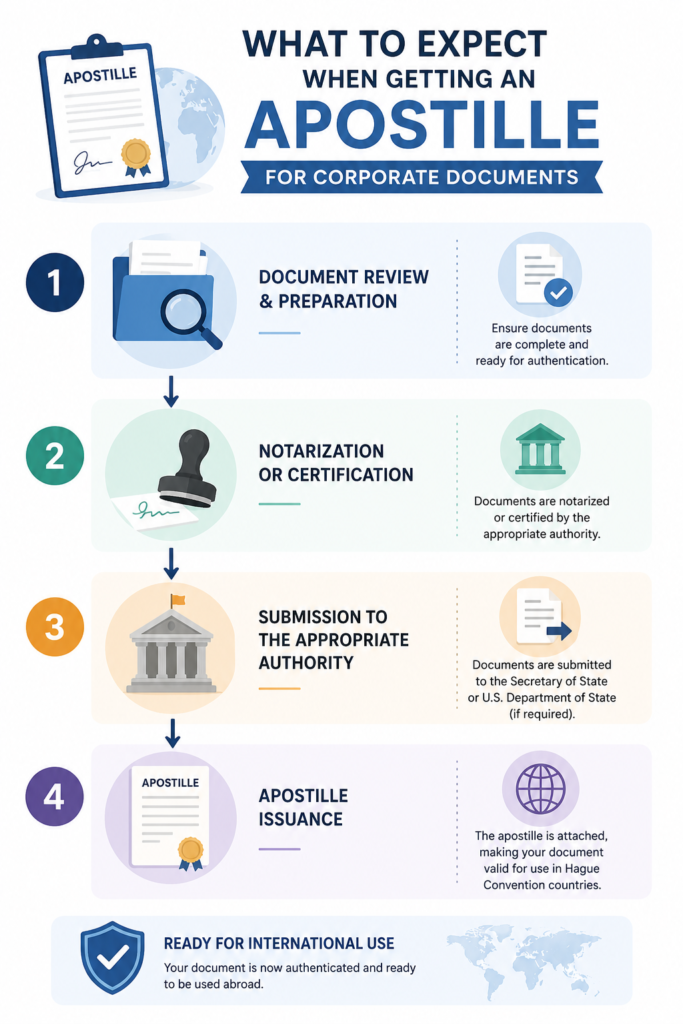
The apostille process varies depending on the document type and destination country, but most businesses can expect several key steps. Knowing what to expect when getting an apostille ahead of time can help organizations avoid unnecessary delays.
- Document Review and Preparation
- Before submitting documents, businesses should confirm:
- Which documents require authentication
- Whether notarization is necessary
- Which country will receive the documents
- Whether apostille or embassy legalization is required
Improperly prepared documents are one of the most common causes of rejection. This is one reason why businesses researching what to expect when getting an apostille often seek professional guidance early in the process.
- Notarization or Certification
Many business documents must first be notarized or certified by the appropriate issuing authority before they can receive an apostille.
For example:
- Corporate agreements may require notarization
- Certified copies may need to be issued by a state agency
- Federal documents may require certification from the originating department
Requirements vary by document type and jurisdiction.
- Submission to the Appropriate Authority
Once prepared, documents are submitted to the designated authority responsible for issuing apostilles.
This may include:
- The Secretary of State for state-issued documents
- The U.S. Department of State for certain federal documents
Processing times can vary depending on workload, document type, and jurisdiction. Businesses learning what to expect when getting an apostille should also plan for potential delays during peak processing periods.
- Apostille Issuance
After verification, the apostille certificate is attached to the document. The document is then recognized for legal use in Hague Convention countries.
At this stage, businesses should carefully review the completed apostille to ensure all information is accurate before international submission.
Apostille vs. Embassy Legalization
One of the most important things businesses should expect is determining whether an apostille is actually sufficient.
Apostilles only apply to countries that participate in the Hague Apostille Convention.
If the destination country is not a Hague member, businesses typically need embassy or consular legalization instead. This process often involves multiple authentication steps through:
- State agencies
- The U.S. Department of State
- The foreign embassy or consulate
Embassy legalization usually takes longer and involves additional requirements. Companies researching what to expect when getting an apostille should confirm destination-country requirements before starting the process.
Common Challenges Businesses Encounter
International document authentication can quickly become complicated. Businesses often encounter issues such as:
- Incorrect notarization
- Missing certifications
- Country-specific formatting requirements
- Tight international deadlines
- Embassy processing delays
- Rejected documents due to technical errors
Even small mistakes can delay overseas operations, banking approvals, or contract execution.
How Long Does the Apostille Process Take?
Turnaround times depend on several factors, including:
- The type of document
- The issuing state or federal agency
- Destination country requirements
- Whether embassy legalization is required
- Current government processing volumes
Some apostilles can be completed quickly, while others may take several weeks if multiple agencies are involved.
Businesses working under strict international deadlines should plan ahead whenever possible. Understanding what to expect when getting an apostille can help companies build more realistic timelines for global transactions and compliance needs.
Why Businesses Use Professional Apostille Services
Because international authentication requirements vary widely, many companies rely on professional apostille providers to manage the process efficiently.
Professional services help businesses:
- Navigate country-specific requirements
- Avoid processing errors
- Reduce delays and rejections
- Coordinate federal and embassy procedures
- Accelerate turnaround times
- Ensure compliance with international standards
With decades of experience and close proximity to embassies in Washington, D.C., Washington Consular Services (WCS) helps organizations streamline complex authentication processes with dependable, high-touch support.
Key Takeaways
- Apostilles authenticate business documents for international use in Hague Apostille Convention countries.
- Businesses commonly need apostilles for expansion, banking, contracts, compliance, and overseas transactions.
- Understanding what to expect when getting an apostille helps companies avoid delays and rejected filings.
- The process typically involves document preparation, notarization or certification, submission to the proper authority, and apostille issuance.
- Requirements vary depending on the document type and destination country.
- Businesses should confirm whether apostille or embassy legalization is required before submitting documents internationally.
- Mistakes in notarization, formatting, or certifications can lead to rejected documents and costly delays.
- Professional apostille services help companies navigate complex international authentication requirements more efficiently.
- Washington Consular Services (WCS) provides dependable corporate document authentication support backed by decades of experience.